
Prologue
The Ledger of the Flesh
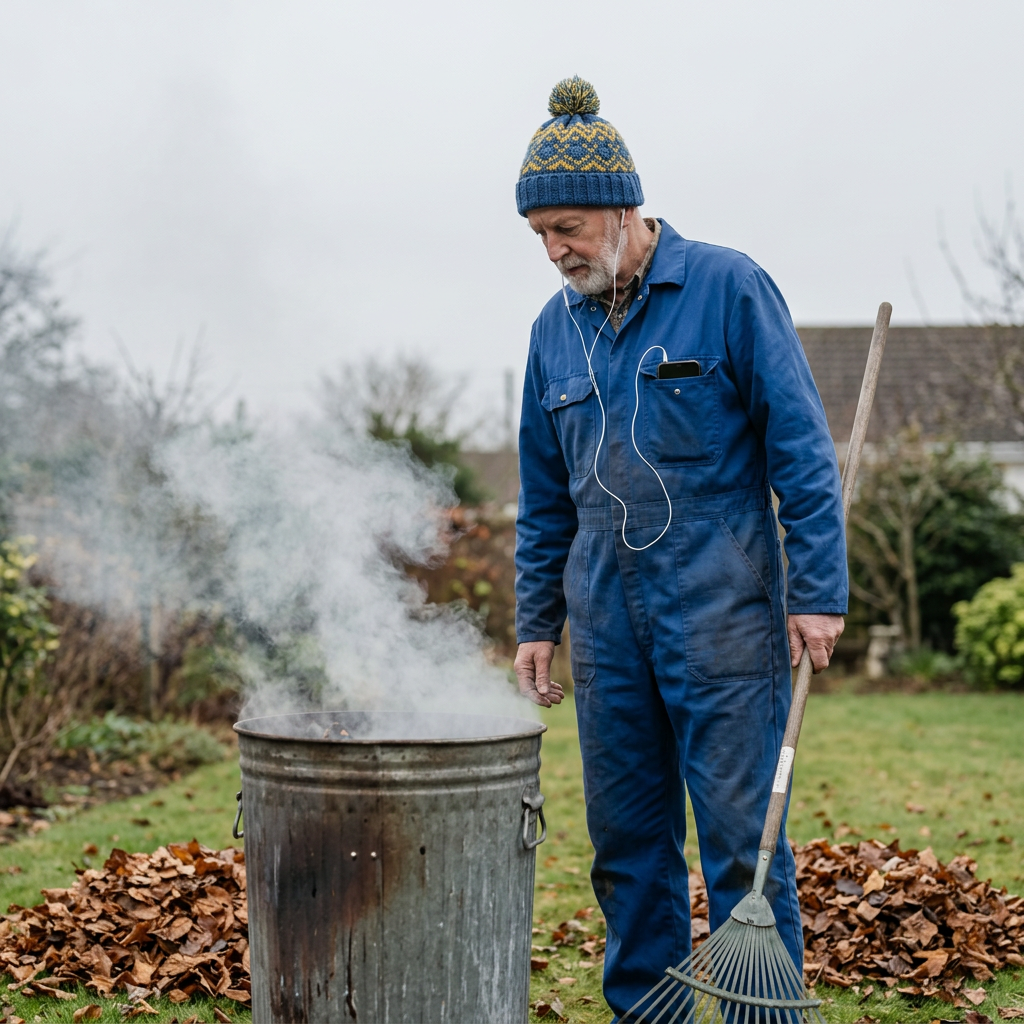
In his garden, the dead beech leaves are raked into temporary piles that will rot long before they ever become compost. It is the February 2026, and James is seventy-one years old. Then through the headphones he wears to keep alone, Bob Harris’s voice murmurs softly through “Sounds of the 70s. Then a sudden, clean guitar figure rises out of the radio static. It is four bars of a melody he hasn’t heard in over fifty years. His rake stops moving. His hands go perfectly still on the wooden handle. Somewhere behind his sternum, a heavy, long-forgotten door swings open on rusty hinges, and the leaves before him blur into a haze of gray mist.
“I did what I did for Maria”
When a man receives a diagnosis like a pancreatic cyst, the world threatens to fall apart in a single afternoon. James spent the immediate aftermath in a frantic panic, decluttering the evidence of a lifetime spent wandering, burning the receipts of his secret histories so the people he leaves behind won’t have to trip over his ghosts. But once the physical clutter is cleared, he is left with the terrifying emptiness of his own mind. He realizes he has only a short, finite currency of time left on this earth, and his final obsession becomes a battle for legacy. He becomes consumed by the need to tell the tale—not just to rerun the film of his existence, but to finally understand the mechanics of how he broke.
To do that, James has had to learn the tools of a world that didn’t exist when he was a flustered seventeen-year-old scrubbing teaspoons in the steam of the Cafe. He sits there now with a new Chromebook, feeding his life into algorithms, using text strings and voice clones to resurrect a century of memory. But as he has mastered these new neural networks, he has simultaneously had to decode a far older operating system: the ancient, warring pantheon inside his own head.
He used to think his life was just a chaotic series of random impulses and social failures. Now, through the act of writing, he has begun to deify and personify his emotional states, mapping them to the Greek gods to understand the internal council that ruled him. For nearly sixty years, his mind was not a single cohesive identity, but a brutal, submissive battlefield:
There was Apollo, his inner “Professor”, who was born in 1967 when he met fourteen-year-old Kate at a Christmas dance—the cold, hyper-analytical shell that tried to decode social cues like mathematical equations, freezing him in place instead of letting him touch. There was Morpheus, his “Man of Mist”who took over in 1968 among the lonely shores of northern Scotland, pulling him into daydreaming and emotional numbness to escape the reality of a strange new world. There was Momus, his “Clown”, who arrived in 1969 to defuse his terror around girls like Grace and Yvonne through performative wit and self-mockery. And there was Hermes, the “People Pleaser”, the anxious "Good Boy" who grew to six feet tall in the summer of 1970 but remained entirely immature, constantly adapting his shape to anticipate and serve the emotional needs of others just to ensure his own safety. There were others, Charon, the unwashed floor hopper from University and Kratos, the power seeker who also emerged at University.
But most of all, there was PAN—the “Madman in his Trousers”
Whenever Pan arrived, he brought literal panic—a raw, feral, autonomous tidal wave of somatic arousal that completely trampled the rest of James's council. Pan woke up fully in 1971 in the Cafe kitchen around Sandra. He drove James through the neon flash of the New Pussycat club, through decades of volatile relationships like Imogen, through secret mid-career affairs, and eventually into the twilight illusions of sugar dating and online scams. Whenever the cognitive dissonance and guilt of Pan’s victories became too agonizing to bear, Silenus, his “Overindulger”, would step in to numb the pain. Sometimes he numbed it with alcohol; later in life, he numbed it through the obsessive, punishing physical exhaustion of Ironman triathlons and ultra-walks—using extreme exercise as just another way to quiet the screaming inside his skull.
Because James could never reconcile the war between the Good Boy and the Madman, he built The ByPass. It began on a cold, dark night in 1971 on the Paisley Street Bridge after Brian and Maria took his boundaries and scraped them raw. The ByPass became his lifelong psychological survival mechanism: the desperate, immediate need to outrun intimacy, to flee from real emotional connection the exact second it threatened to wound him. He bypassed Maria; he bypassed the offices in Torbay; he bypassed his own marriage even while it worked; he bypassed everything until the physical and mental catastrophe of his 2008 breakdown left him isolated from the world. And the 2023 diagnosis and operation brought the reality of mortality to his waking moments.
This project is his confession. It is the chronological ledger of a man who spent his life hiding behind his own eyes, running along the shoulder of a dark highway at one o'clock in the morning with his thumb raised at nothing.
But a true legacy cannot just be a monument to his own self-loathing. To give this history actual weight, James is using the newly available digital tools to perform an act of deep narrative penance. For every encounter where he let Pan rule him at the expense of his soul, he is forcing the machine to strip away his narrow, panicked perspective. He is using it to construct ”The Shadow Tale” —the memory imagined entirely from the perspective of the women involved. He wants to see Kate’s unhurried rhythm; he wants to map Sandra’s calculated, ego-stoking power; he wants to look through Maria’s eyes as she watched his rigid defenses dissolve into the sea. He wants to imagine that those who are still alive will remember him.
He is writing this because he wants to finally recognize how these people shaped the architecture of his existence. He is standing naked on the edge of the water one last time, looking at the ghosts of the people who tried to make him whole, and wondering what the rest of this short life will be.